
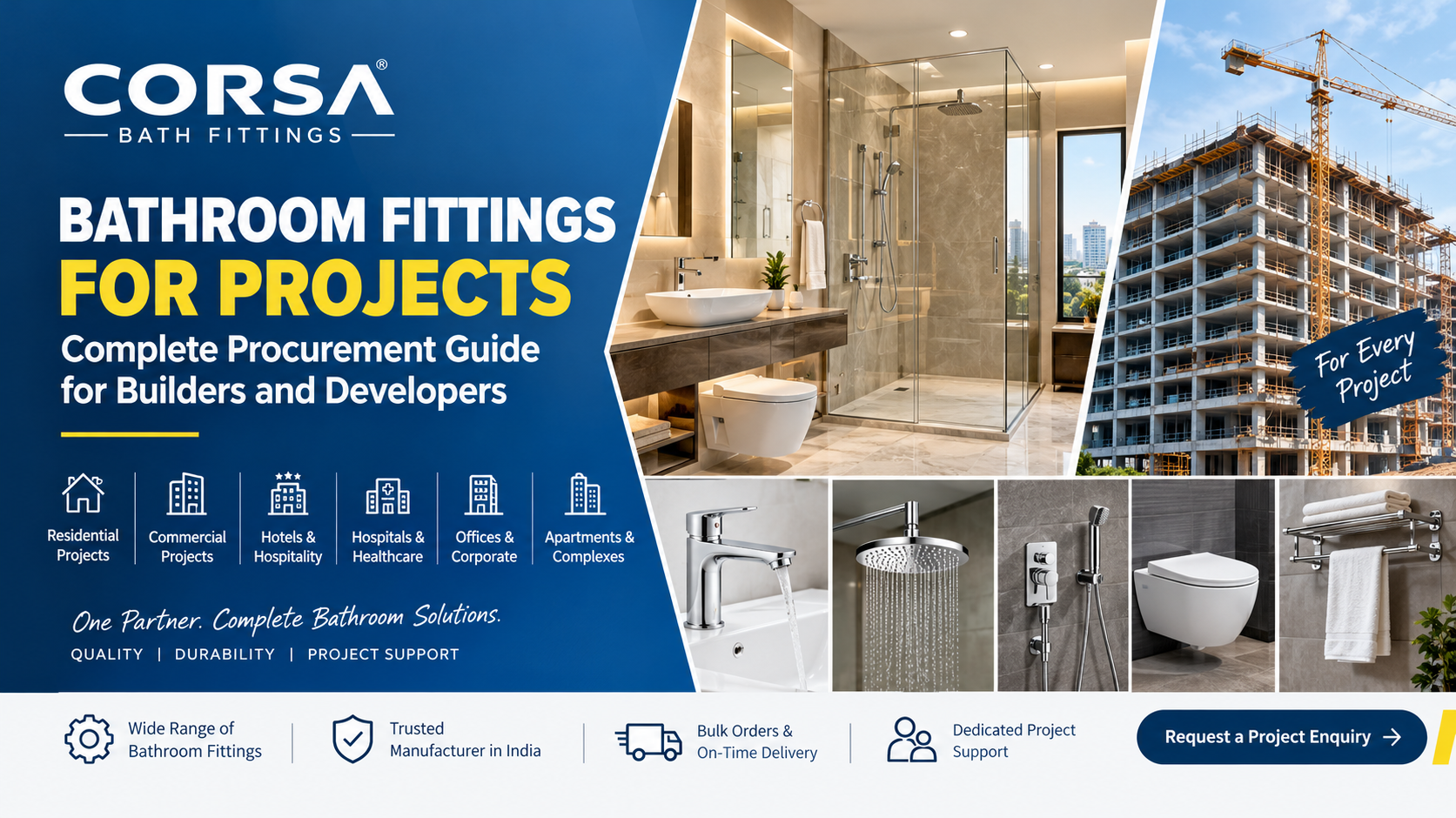
Anyone who has worked on a construction project knows that the small decisions can become big problems if they are left until the last minute. Bathroom fittings are a good example. A tap, shower, drain or accessory may look like a small part of the overall building, but when a project has dozens or hundreds of bathrooms, the right product selection affects the budget, installation schedule, maintenance work and the finished look of the property.
That is why choosing bathroom fittings for projects should be part of the planning process, not something left until the finishing stage. Builders and developers need products that suit the design, meet the project specifications, are available in the required quantities and can be supported after installation.
The needs of a residential apartment project are not always the same as those of an office, hospital, hotel or shopping complex. Still, the questions are familiar: Which products are required? Can the supplier handle bulk quantities? Are the fittings compatible with the plumbing plan? What are the delivery timelines? And who can the team contact if something needs attention later?
Corsa Bath, an Indian bathroom fittings manufacturer and supplier established in 1996, offers bathroom faucets, showers, mixers, accessories, drainage and allied products, kitchen faucets and other related categories. This guide explains how builders, developers, contractors, architects and procurement teams can plan their bathroom fittings requirements and evaluate suppliers before placing an order.
1. What Do Bathroom Fittings for Projects Usually Include?
The product list depends on the building type, number of bathrooms, design brief, plumbing plan and budget. A residential project may need a different combination from a hospital or commercial office, so it helps to start with a clear schedule rather than ordering products one by one.
| Area or requirement | Products to consider | What the project team should check |
| Wash basin | Basin mixers, basin taps, pillar taps | Basin type, installation dimensions and finish |
| Shower area | Overhead showers, hand showers, shower sets | Water supply, compatibility and intended use |
| Water controls | Mixers and diverters | Plumbing layout and installation requirements |
| Toilet area | Health faucets and flushing products | Ease of use, compatibility and maintenance |
| Bathroom storage and convenience | Towel rails, robe hooks, shelves and holders | Placement, finish and consistency |
| Floor drainage | Tile drainers and floor drains | Drain size, floor design and drainage requirements |
| Concealed systems | Concealed cisterns and related products | WC compatibility and access for servicing |
| Kitchen areas | Kitchen faucets and related fittings | Sink type and intended application |
| Shared or public washrooms | Commercial bathroom fittings and accessories | Frequency of use and maintenance needs |
Before requesting quotations, prepare a product schedule or BOQ (Bill of Quantities). It should identify the product category, quantity, preferred finish, technical requirements and installation details wherever possible. A clear BOQ gives suppliers the same information and makes quotations easier to compare.
2. Start With the Project Type and Its Real Requirements
There is no single list of fittings that works for every building. A developer building apartments for families may prioritise practical designs, consistent finishes and straightforward replacement. A hospital project may need to consider cleaning routines, accessibility and the needs of different users. An office or retail building may place more emphasis on shared washrooms and frequent daily use.
Before choosing products, ask the project team:
Who will use the bathrooms, and how often?
What level of finish does the design specify?
Are there standard products for every unit, or different specifications for premium areas?
What plumbing connections and installation conditions are already planned?
What is the budget for products, installation and future maintenance?
When must the products reach the site?
These questions may sound basic, but answering them early can prevent rushed substitutions later. A product that looks right in a catalogue still needs to suit the actual site and specification.
3. Bathroom Fittings for Residential Projects
For apartment buildings, housing societies, villas and other residential developments, consistency matters. When a project includes many bathrooms, using suitable standard products across similar units can make purchasing, installation and later maintenance more manageable.
Depending on the design, a residential bathroom fittings schedule may include basin faucets, mixers, showers, diverters, health faucets, accessories, drains and concealed flushing products. Premium units may have different finishes or product configurations from standard units, so note those differences clearly in the BOQ.
For builders and developers, useful checks include:
Confirming the product dimensions and installation type.
Matching faucets and mixers to the basin and plumbing layout.
Selecting finishes that suit the interior specification.
Checking supply availability for the full quantity.
Confirming warranty conditions and replacement support.
Keeping product codes and specifications in the handover records.
A little organisation at the procurement stage can make a real difference when the maintenance team takes over the property. It is much easier to identify a fitting later if the product schedule has been kept properly.
Explore the Corsa Bath bathroom faucet range (https://www.corsabath.in/bathroom-faucets.php) and the wider Corsa Bath product categories (https://www.corsabath.in/category.php) when preparing your project list.
4. Bathroom Fittings for Commercial Projects
Commercial projects bring their own practical challenges. Offices, hospitals, educational buildings, shopping centres, restaurants and other public-facing properties can have washrooms that see frequent use throughout the day. The right product choice should take the building’s use, maintenance plan and technical specification into account.
When sourcing bathroom fittings for commercial projects, pay particular attention to the intended application, installation requirements, cleaning routine, availability of replacement parts and service arrangements. For healthcare or other specialist buildings, the design and project consultants should identify any additional requirements that apply to the facility.
A useful approach is to separate the product schedule by area: staff washrooms, visitor washrooms, accessible washrooms, patient or guest areas, service spaces and other locations. This helps avoid assuming that every room needs exactly the same fittings.
5. Choosing a Bathroom Fittings Supplier for Builders
A supplier should be evaluated on more than the price quoted per item. A low initial price may not be the best value if the product does not match the specification, supply is delayed or replacement support is unclear.
When comparing a bathroom fittings supplier for builders, check the following:
| What to compare | Questions to ask |
| Product range | Can the supplier cover several categories required by the project? |
| Technical information | Are dimensions, materials and installation details available? |
| Quantity | Can the required volume be supplied within the project schedule? |
| Availability | What is in stock, and what needs to be ordered? |
| Finish options | Are the specified finishes available for the chosen products? |
| Quality information | What product documentation or testing information can be provided? |
| Warranty | What terms apply to each product category? |
| Service | How are product issues or warranty claims handled? |
| Replacement parts | Can compatible parts or replacement products be sourced? |
| Commercial terms | What are the payment, delivery and quotation conditions? |
Ask each supplier for the same information. That makes it easier to compare offers fairly and identify any missing details before approval.
6. Why Bulk Bathroom Fittings Procurement Needs Planning
Bulk purchasing can make procurement more organised, but it needs proper coordination. A project may require hundreds of faucets, showers, accessories and other fittings, sometimes in more than one finish or model. If the quantities or specifications change late in the process, the team may have to revise orders or adjust the installation schedule.
For bulk bathroom fittings supply, prepare the following before asking for a final quotation:
A current BOQ with quantities by product and building area.
Technical specifications and preferred product codes, if already selected.
Finish requirements and any approved alternatives.
The site delivery location and expected delivery phases.
A realistic installation schedule.
Details of packaging, storage and site receiving requirements.
A process for approving samples or product substitutions.
It is also worth agreeing how changes will be handled. If the design team revises a finish or the site quantity changes, both the supplier and procurement team should know who can approve the change and how it affects cost and timing.
7. Faucets, Mixers and Showers: Check Compatibility Before Ordering
Faucets, mixers and showers are among the most visible parts of a bathroom, but appearance is only one consideration. The products must suit the basin, shower layout, water connections and installation details.
Depending on the project, the schedule may include basin mixers, pillar taps, wall-mounted mixers, overhead showers, hand showers, shower sets, bath mixers and diverters. Check product dimensions, installation type, required components and finish before approving the selection.
For concealed products, confirm the rough-in dimensions and installation instructions before walls are closed or tiles are laid. Fixing an incompatibility after finishing work is complete can add labour and delay the handover. A quick technical review at the right time is usually easier than trying to correct a problem on site.
8. Bathroom Accessories: Small Items, Big Coordination
Accessories are sometimes left until late in the procurement process, even though they affect both usability and the finished appearance. Depending on the design, the list may include towel rails, towel rings, robe hooks, toilet paper holders, soap holders, shelves and other bathroom accessories.
For multi-unit projects, make sure the quantity schedule includes all bathrooms and any shared facilities. Also check the mounting position, fixing requirements and finish. Coordinating accessories with the main fittings can help the final bathroom look intentional rather than assembled from unrelated products.
Corsa Bath includes bathroom accessories in its broader product range. Review the Corsa Bath product catalogue (https://www.corsabath.in/category.php) to explore available categories.
9. Drainage and Tile Drainers Should Not Be an Afterthought
Drainage may not be the first thing people notice in a finished bathroom, but it matters every day. The product must suit the floor design and installation, and it should be appropriate for the expected use.
Before selecting tile drainers or floor drains, check the dimensions, material, finish, drainage requirements, tile compatibility, cleaning access and installation instructions. Coordinate the selection with the plumbing contractor and site team so the drain works with the floor build-up and waterproofing details.
For a project with many bathrooms, include drainage products in the main BOQ rather than leaving them for separate last-minute purchasing. This makes it easier to track quantities and coordinate delivery.
See the Corsa Bath product categories (https://www.corsabath.in/category.php) for related bathroom and drainage products.
10. Concealed Cisterns and Flushing Products
Concealed cisterns can create a cleaner, more streamlined look, but they need to be selected and coordinated before construction reaches the finishing stage. The system must be compatible with the WC and flush plate, and the installation must allow for appropriate maintenance access.
Before ordering, verify dimensions, wall requirements, water connections, compatible components and the installation instructions. Ask the relevant technical team to confirm the arrangement against the project drawings. This is especially important where the same detail will be repeated across many apartments or washrooms.
The Corsa Bath sanitaryware and accessories page (https://www.corsabath.in/sanitaryware-accessories.php) is a useful starting point for reviewing related product categories; confirm specific concealed cistern availability and compatibility directly with the supplier.
11. Quality, Warranty and After-Sales Support
Once a building is occupied, a small fitting issue can become a repeated maintenance task if the product details and service process are unclear. That is why quality information, warranty terms and replacement arrangements should be part of procurement—not questions saved for after installation.
When assessing bathroom fittings manufacturers in India, ask for the information relevant to the selected products. This may include material and finish details, product specifications, installation instructions, applicable test information, warranty coverage and the process for obtaining service or replacement parts.
Warranty terms can vary between products, so avoid assuming that one warranty applies to every category. Keep the approved product list, invoices, warranty documents and installation records together so the owner or facility manager can refer to them later.
12. How Architects and Contractors Can Coordinate the Specification
A project runs more smoothly when the architect, plumbing consultant, contractor, procurement team and supplier are working from the same information. If each team uses a different product list or an outdated drawing, mismatches can show up during installation.
A practical coordination process looks like this:
The architect or designer prepares the design intent and finish schedule.
The plumbing consultant confirms technical and installation requirements.
Procurement prepares the BOQ and requests comparable quotations.
The selected supplier provides product details for review.
The relevant team approves the products and any samples required.
Site teams receive the final product schedule and installation instructions.
The handover team keeps product and warranty records.
The exact process will vary by project, but the key is to make sure that product changes are recorded and approved rather than passed along informally.
13. Why Consider an Established Manufacturer for Project Supply?
For a builder or developer, speaking directly with a manufacturer can be useful when discussing product specifications, quantities, finishes and delivery requirements. Depending on the supplier and the commercial agreement, it may also make it easier to review several related product categories in one conversation.
Corsa Bath is an Indian bathroom fittings manufacturer and supplier established in 1996. Its product categories include bathroom faucets, showers, mixers, diverters, bathroom accessories, drainage and allied products, kitchen faucets and other related items. Project teams can review the range and confirm whether the products match their specifications, availability requirements and budget.
Visit the Corsa Bath product catalogue (https://www.corsabath.in/category.php) to explore categories, or use the Corsa Bath contact page (https://www.corsabath.in/contact.php) to discuss a project requirement.
14. How to Prepare a Project Enquiry
You do not need a perfect document to start a conversation with a supplier, but the more useful detail you can share, the more focused the discussion is likely to be.
Prepare these details where possible:
| Information | Why it helps |
| Project type | Identifies whether it is residential, commercial or mixed-use |
| Project location | Clarifies the delivery destination |
| Number of units or bathrooms | Helps estimate quantities |
| Product schedule or BOQ | Defines the required categories and quantities |
| Preferred products and finishes | Helps narrow down suitable options |
| Technical specifications | Supports compatibility checks |
| Required delivery dates | Helps the supplier discuss lead times |
| Budget or commercial requirements | Helps establish the project’s purchasing parameters |
For example, a developer might say: “We are working on a residential project with 120 apartments and need basin mixers, showers, health faucets, bathroom accessories and drainage products. Please review the attached BOQ and confirm suitable options, availability and delivery timelines.”
A clear enquiry helps everyone get to the practical questions sooner. To discuss your requirement, contact Corsa Bath (https://www.corsabath.in/contact.php).
15. Project Procurement Checklist
Before confirming your order, review this checklist with the relevant teams:
☐ Final product schedule or BOQ prepared
☐ Quantities checked by building area and bathroom type
☐ Product specifications reviewed
☐ Installation dimensions and compatibility confirmed
☐ Finishes approved
☐ Samples reviewed where needed
☐ Availability and lead times confirmed in writing
☐ Delivery phases and site receiving arrangements agreed
☐ Warranty terms checked for each category
☐ After-sales and replacement process understood
☐ Product documents and installation instructions collected
☐ Any applicable standards or certifications verified
☐ Commercial terms and approved substitutions documented
☐ Final product schedule shared with the site team
This simple review can help catch missing details before the order is released.
Frequently Asked Questions
1. What are bathroom fittings for projects?
Bathroom fittings for projects are the faucets, mixers, showers, accessories, drainage products, flushing products and other items specified for residential or commercial construction. The exact list depends on the building type and project design.
2. How do builders choose a bathroom fittings supplier?
Builders should compare product range, technical information, quality documentation, quantity capacity, availability, delivery timelines, warranty, after-sales support and commercial terms. Asking each supplier the same questions makes comparisons more reliable.
3. Can a supplier provide bulk bathroom fittings for apartments?
Supply capacity varies by supplier and product. Share the BOQ, required quantities, finishes and delivery schedule so the supplier can confirm availability and proposed timelines before an order is placed.
4. What should be included in a bathroom fittings BOQ?
A useful BOQ includes product category, description or product code, quantity, finish, relevant technical specifications, installation requirements and the area where each item will be used.
5. Why should bathroom fittings be selected before finishing work?
Some fittings, particularly concealed products, need specific dimensions and connections before walls are closed or tiles are installed. Confirming compatibility early can reduce rework and installation delays.
6. Are bathroom accessories part of project procurement?
Yes. Accessories such as towel rails, robe hooks, soap holders, shelves and toilet paper holders should be included in the product schedule so quantities, finishes and fixing requirements are not missed.
7. What should be checked in a product warranty?
Confirm the warranty period, what is covered, exclusions, claim process and availability of service or replacement parts. Conditions may vary by product category.
8. Can Corsa Bath be contacted for residential and commercial projects?
Builders, developers, architects, contractors and procurement teams can contact Corsa Bath with their project details and product schedule to discuss relevant categories and supply requirements. Visit the Corsa Bath contact page (https://www.corsabath.in/contact.php).
9. Where can I review Corsa Bath products?
Visit the Corsa Bath product catalogue (https://www.corsabath.in/category.php) to review product categories. Confirm specific product specifications, availability and suitability with the company before finalising your project order.
10. Where can I check applicable Indian product standards?
The applicable standard depends on the product. Check the relevant requirement and confirm any required compliance documents with the manufacturer or project consultant. The Bureau of Indian Standards — Know Your Standard (https://www.bis.gov.in/Know-Your-Standard/?lang=en) resource can help you research Indian Standards. You can also review the BIS Product Certification overview (https://www.bis.gov.in/product-certification/product-certification-overview/).
Conclusion: Make Bathroom Fittings Part of the Project Plan
Bathroom fittings may be a small line in a construction budget, but the choices affect how a building looks, how smoothly installation proceeds and how manageable maintenance will be after handover. The best approach is to plan the product schedule early, check technical compatibility, compare suppliers on consistent criteria and confirm quantities, lead times, warranty and support before placing the order.
For builders and developers, a well-prepared BOQ and a clear line of communication with the supplier can save time and help prevent avoidable confusion on site. Corsa Bath, established in 1996, offers bathroom fittings and related product categories that project teams can assess against their requirements.
If you are planning a residential, commercial or mixed-use development, share your project details and product schedule with Corsa Bath to discuss suitable options.
Corsa Bath product categories: https://www.corsabath.in/category.php
Corsa Bath sanitaryware and accessories: https://www.corsabath.in/sanitaryware-accessories.php
Corsa Bath tile drainer: https://www.corsabath.in/tile-drainer.php
Corsa Bath dealership: https://www.corsabath.in/dealership.php
Corsa Bath contact / project enquiry: https://www.corsabath.in/contact.php
Corsa Bath homepage: https://www.corsabath.in/
BIS — Know Your Standard: https://www.bis.gov.in/Know-Your-Standard/?lang=en
Suggested anchor: *BIS Know Your Standard*
BIS — Product Certification overview: https://www.bis.gov.in/product-certification/product-certification-


